
Sorry, but your login has failed. Please recheck your login information and resubmit. If your subscription has expired, renew here.
Supply chain management has faced unprecedented volatility in recent years, driven by the COVID pandemic, environmental shifts, global trade tensions, changing consumer preferences, and technological transformation. Traditional risk mitigation strategies like safety stock and alternate suppliers are costly and often insufficient for large-scale disruptions. Today, advanced planning technologies (APT) enable faster, more comprehensive planning and replanning, helping leading firms seize opportunities and manage risks more effectively. These “next level” planning capabilities are differentiating leading firms by empowering them to more quickly seize upon new opportunities and effectively manage risks.
Supply chain executives need to understand the capabilities that these functions provide. They must also understand the critical organizational processes and structures needed to leverage APT’s capability impacts. Over the past few years, we conducted three research projects to quantify the financial impacts of APT adoption and use.
SC
MR
Sorry, but your login has failed. Please recheck your login information and resubmit. If your subscription has expired, renew here.
Supply chain management has faced unprecedented volatility in recent years, driven by the COVID pandemic, environmental shifts, global trade tensions, changing consumer preferences, and technological transformation. Traditional risk mitigation strategies like safety stock and alternate suppliers are costly and often insufficient for large-scale disruptions. Today, advanced planning technologies (APT) enable faster, more comprehensive planning and replanning, helping leading firms seize opportunities and manage risks more effectively. These “next level” planning capabilities are differentiating leading firms by empowering them to more quickly seize upon new opportunities and effectively manage risks.
Supply chain executives need to understand the capabilities that these functions provide. They must also understand the critical organizational processes and structures needed to leverage APT’s capability impacts. Over the past few years, we conducted three research projects to quantify the financial impacts of APT adoption and use. Our research focused on the following three questions.
- How does APT adoption affect financial performance?
- Does APT usage improve resilience to disruptions?
- What implementation factors drive greater performance?
The following sections summarize our findings. Our findings explain the fundamental capabilities and performance gains enabled by APT and the required improvements in planning organizations and processes that go with it. In the final section of this article, we describe the fast-emerging, next stage of advanced AI-powered planning technology, and the even more amazing capabilities that we might expect to see in the next few years.
Capabilities of APT
The “control tower” concept describes APTs as central hubs integrating technology, people, and processes to capture and use supply chain data for better decision-making (Sheffi, 2015; Deloitte, 2021). Control towers enable real-time collaboration, process visibility, and advanced analytics, organizing data and actors through integrated planning. Hence, control tower-type APTs enable a high level of information processing by organizing data and interdependent actors through integrated planning and replanning processes. Consider the following examples:
Example 1: Electronics and fiber optics systems manufacturer
Acquisition-driven growth at this company produced a host of non-standard processes, information silos, and a fragmented ERP landscape. The company’s supply chain leaders often found themselves developing workarounds to harmonize disconnected plans and overcome data latency while paying heavy premiums for expedited deliveries in order to keep customers happy. Scenario planning was cumbersome, and planners lacked timely data-driven decision-making capabilities.
The company invested in APT to connect planning at 50 global plants. They now have integrated visibility, inventory and factory modelling, and fast “what-if” scenario-based planning to enhance scheduling and inventory management. As a result, they have seen a 10% reduction in inventory, a 20% reduction in premium freight costs, increased agility in decision-making and reduced decision latency.
Example 2: Scientific instruments manufacturer
This company sought ways to better link planning across functional silos and disparate ERP systems across its operations and those of its suppliers. They worked with critical suppliers to link their APTs to provide visibility, simulate constraints, prioritize allocation of limited supply, and predict revenue and other operational impacts. In addition, the company and its partners improved responsiveness by using the system to make new order delivery-time commitments, and to model and plan responses to supply chain shortages. Before making these co-development efforts, use of different ERP platforms by the company and its suppliers meant that actions such as performing inventory translations, checking order feasibility, and predicting shortages required three to four weeks. The new planning technology enabled decision makers to perform these checks in as little as four hours. Using the modeling capacity of the system, the company quickly identified alternative part sources and, in certain instances, implemented redesigns that incorporated available substitute components.
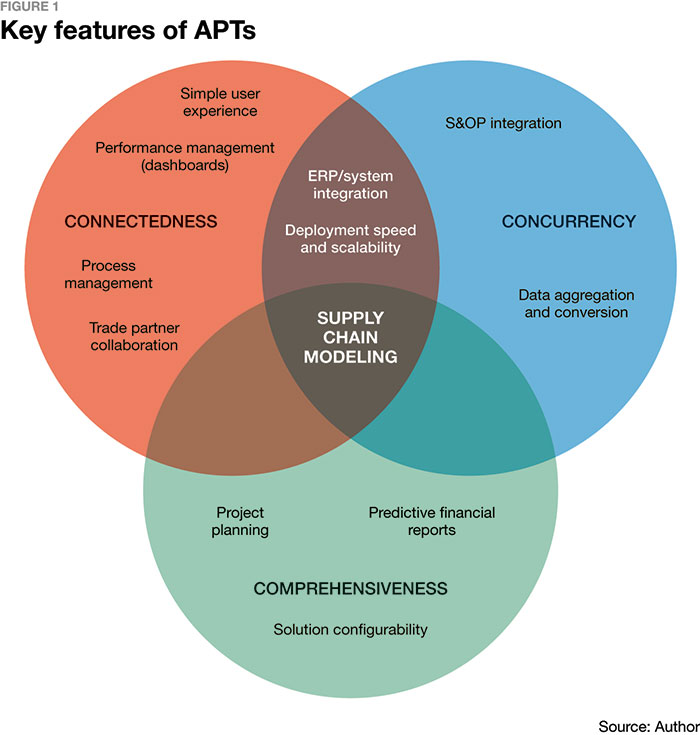
These examples highlight three fundamental APT capabilities: comprehensiveness, connectedness, and concurrency.
- Comprehensive planning involves objective evaluation, intensive trade-off analysis, and thorough contingency planning. Rapid scenario evaluation and broader stakeholder involvement improve the scope and quality of planning.
- Connectedness enables systematic coordination and integrated access to information across partners and functions, supporting visibility and collaboration.
- Concurrency reflects speed and parallel processing, eliminating information latency through coordinated, connected planning. Automation and near-simultaneous adjustments enable real-time decision-making. Few APT platforms offer true concurrent planning, which is critical for understanding current and potential future states. Most systems still rely on slow, sequential processes.
Figure 1 illustrates key features of APTs as indicators of the underlying capabilities of comprehensiveness, connectedness, and concurrency.
Measuring the impacts of APT implementation
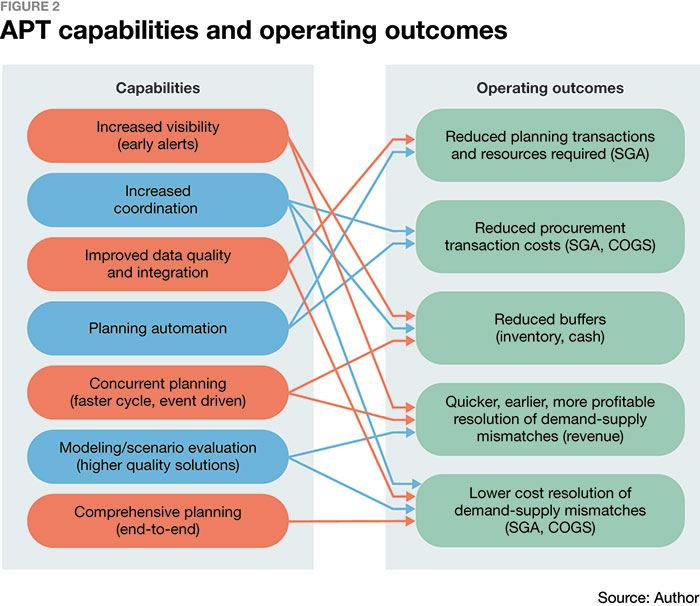
Any good research project starts with understanding the reasoning that drives the researchers’ expectations. Starting with a grasp of the capabilities discussed above, we consulted both the academic literature and practitioner subject-matter experts to think about how APT might improve planning processes, and further, how these improvements would be reflected in financial outcomes that show up on a firm’s financial statements. Figure 2 illustrates these “causal” linkages. APT platforming, computing power, data management, transaction automation, and modelling capabilities fundamentally change planning processes in several critical ways. First, these features should improve the efficiency of planning and change management by reducing transactional overhead. Less effort is required to perform analyses and make translations between decision-makers’ systems (usually different spreadsheets). Second, APTs reduce the uncertainty and negative impacts of disruptions by improving decision-making speed (responsiveness) and scope. Accordingly, firms should become less reliant on buffers such as just-in-case inventory, excess capacity, and cash to cover operations during shortages or demand spikes. Third, greater intelligence provided by APT-enhanced planning (higher quality solutions to planning problems) should produce resolutions to disruptions that are lower in cost and higher in profit preservation. For example, clearer insights into the projected impacts of a product shortage enable more efficient resource rationing and more profitable customer prioritization.
Using these reason-based expected impacts as our guide, we first analyzed pre-to-post adoption changes in financial metrics for firms that have adopted APT. The data included adoptions going as far back as 15 years, though most adoptions occurred in the last five years. (Partners at Kinaxis provided adoption timing and other non-proprietary data for some firms. Data for other adopting firms were procured from subscription data sources that track firms’ technology adoptions: http://www.appsruntheworld.comand www.oceanfrogs.com. Both services track adoptions of enterprise applications by scanning publicly available documents, performing surveys of applications vendors and customers, and from other verifiable sources.) For each firm, we assembled financial data for each year starting from three years before adoption to three years after adoption. To compute a benchmark for comparison, we also collected financial data for all other firms in each adopting firm’s industry sector.
Figure 3 shows the average percentage change in selected financial metrics for APT adopting firms in the first three years after adoption. Each data point shows the average change in a firm’s relative performance for a given year after adoption. A relative performance gain indicates that the firm improved as compared to the firm’s two-year average pre-adoption (baseline) performance; this improvement also takes into account the average change in the firm’s industry competitors’ performances over the same time period. For example, the results show that the average APT-adopting firm realized a one percentage point relative ROA improvement in its first year after adoption; this represents a one percentage point improvement above the average industry change in ROA over the same period. So, if the industry average ROA improved by two percentage points in the adoption period, the result indicates that the average adopting firm realized a three percentage point ROA gain, a one percentage point advantage. This way of measuring performance nets out the effects of overall industry economic factors and allows for cross-industry comparison.
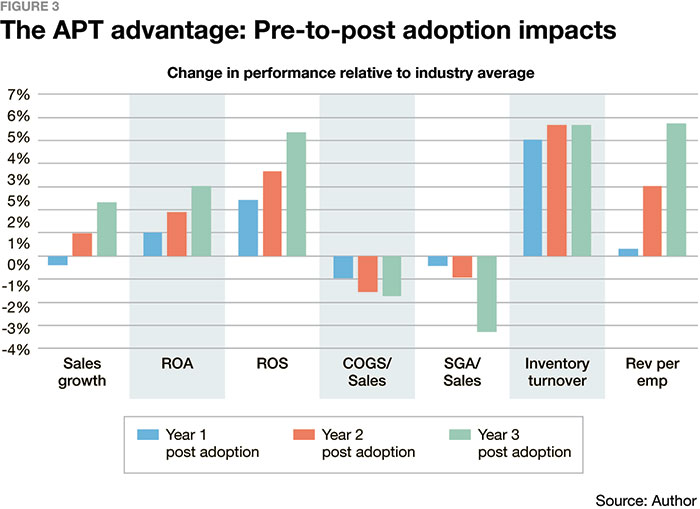
A one percentage point ROA gain on industry competitors is huge—a net one percentage point ROA gain for the average-sized company in our sample equals $330 million to the bottom line. Even better, the results in Figure 2 show that the relative performance numbers consistently increase from year one to years two and three for all of the metrics.
To gain insights into how APT adoptions were driving these types of performance gains, we surveyed 40 planning managers at firms that had adopted an APT within the most recent three years. Figure 4 shows their responses to the question, “How has APT implementation impacted your analysis and decision-making process?” More than half of the respondents indicated that APT enhances visibility and fosters alignment across functions—the “connectedness” capabilities we described earlier. Other responses reflecting improved decision-making speed and scope correspond to the “concurrency” and “comprehensiveness” capabilities.
To dive even deeper, we interviewed planning leaders at four adopting firms. When asked how APT differs from planning functions embedded in ERP systems or other alternatives, they described faster, more comprehensive scenario evaluation capability, from hours or even days with ERP to minutes with APT. Interviewees also noted the use of cloud-based delivery, APIs and flat-file integrators to improve interfaces across systems, in-memory processing, constrained MRP, and other improved functionalities over ERP-based systems and disconnected Excel spreadsheets.

Research project 2: Quantifying how APT impacts supply chain resilience
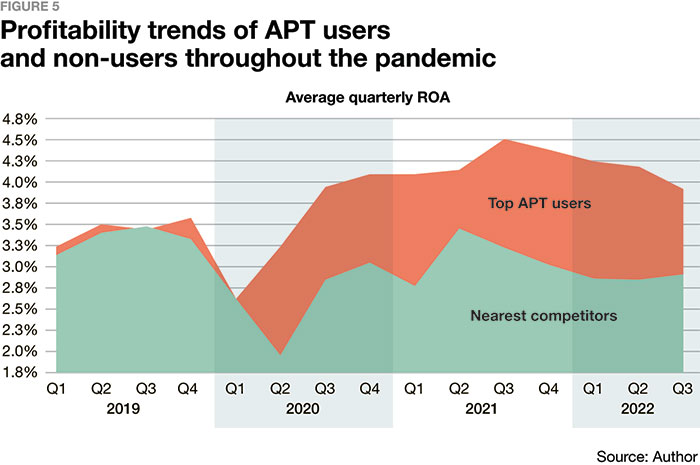
Measuring an organization’s resilience in a data-driven way is difficult; one needs to isolate the effects of an organization’s capabilities from all the factors in a disruptive environment. The COVID-19 pandemic represents one of the most disruptive periods in history. To assess responsiveness to disruptions, we compared APT users and their nearest competitors before and during the COVID-19 period. Figure 5 shows the average quarterly profitability trends of both groups. In the quarters leading up to the pandemic (2019), the ROA values for the two groups are virtually indistinguishable (differences are not statistically significant). Then both groups saw profitability decline in early 2020, but APT users rebounded one quarter faster and maintained a profit advantage for at least two years, even gaining market share. Thus, APT-enabled resilience produced both top-line and bottom-line benefits.
Interviews with several of the user firms highlighted instances where planners were able to quickly identify the impacts of a given disruption, evaluate options, and then simultaneously communicate response plans to many stakeholders. For example, two interviewees described scenarios in which they used APT to quickly identify ways a specific supply shortage would affect the production plan and order fulfilment. Another interviewee explained how they used the APT to gain access to suppliers’ forecasts, purchase orders, and bills of material. This visibility pointed out a looming material shortage emanating from a tier-2 supplier’s labor issues. Early warning of the shortage enabled them to calculate production impacts and quickly secure another source for the material, thus “cornering the market” for the material before competitors were able to secure supply. Another interviewee explained that APT gave them early insights into the impacts of changes in customer orders and forecasts; they were dramatically increasing forecasts and orders to secure scarce supplies of integrated circuits. The interviewee’s firm quickly estimated projected inventory impacts of these changes, enabling them to negotiate with customers to make more sensible orders.
Research project 3: Understanding drivers of successful APT implementation
Our survey indicates that firms can go live and start generating value within six months, while reaching full maturity may take one to three years. To maximize performance, most organizations find they need to improve data quality and governance—and the best APT have tools to accelerate both. Many organizations also find an advantage in combining the traditional demand or supply planner roles into a single network planner role to take advantage of newfound levels of visibility and scenario planning.
Figure 6 illustrates the APT adopters’ responses to a question inquiring on contributions to planning performance. These results show that availability of usable data and scope of application across the organization are the top two most important factors contributing positively to the success of APT implementations. One respondent noted that integration with seven different global ERP systems used across the company increased the challenge of, and the benefits from, assembling unified master data. Others noted slow adoption and limited resources for development as key challenges. More than 30% of respondents rated the availability of skilled personnel as the most important limiter to improved planning performance. Relatedly, about 20% of respondents highlighted insufficient training as a limiter to performance improvements.
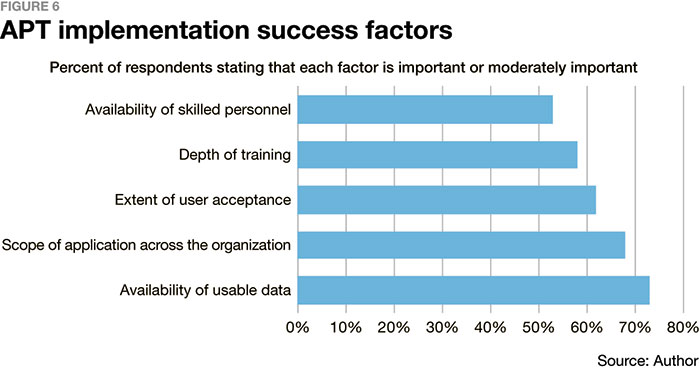
Collectively, these results highlight the importance of data and people. New adopters can look at these requirements as opportunities not only to build technology readiness but to build bridges with both internal and external partners with the aim of continuous improvement in planning processes.
AI-enhanced supply chain planning and orchestration
Next-level APTs are evolving from control towers to orchestration platforms, enabling continuous replanning and optimization. Importantly, next-level APT providers are moving away from traditional transaction management technologies toward platforms built upon specialized, uniquely designed technologies. AI is supporting this evolution by adding intelligence, frictionless user interactions, and autonomous processing capabilities that supplement the comprehensiveness, connectedness, and concurrency capabilities already offered by specialized APT platforms.
APTs have made use of embedded, narrow AI applications (e.g., machine learning, optimization) for at least a decade. Now they are layering in generative AI to enhance planners’/users’ interactions with narrow AI apps. For example, a user might ask, “How do I filter a worksheet?” Instead of scouring documentation, a user can chat a question that returns links to the exact information being sought. This functionality accelerates learning when planners are just beginning to use a new system.
The real power of generative AI is its ability to answer “what if” questions by interacting with data and solver programs. For example, a planner might ask, “Which accounts missed forecast by 10%?” The system instantly examines demand workbooks, gets the answer, and chats it back to the planner. Further developments allow planners to interact with data in the data fabric itself. In this application, AI answers questions by interacting with the data layer and supporting solver programming. Consider a question like, “What would be the impact of a 10% tariff?” The answer to that question does not exist in any worksheet. In order for AI to generate an answer, it must combine broad access to data with tested, codified, and accurate solvers. The AI model needs to understand how to introduce the tariff to a solver that can then calculate the impact. Language models alone are not good at “reasoning” such an impact; planners need language models that know how to execute a solver program to estimate the impact. Simply reasoning a solution will encourage generative AI to hallucinate and miss critical constraints in the supply chain that may prevent a solution from being actionable.
In order to make generative AI-supported “what if” analysis and planning really work, there needs to be at least as much effort in building the tools and algorithms that comprehend the supply chain, including internal and external players and stakeholders, capabilities, and constraints. Planning and replanning excellence depend on the degree to which the system can embed and constantly update the “ontology” of the supply chain, that is, the definition of every relevant component and every relationship among components. While a complete and comprehensive ontology may never be achieved, every increase in the defined components captured in the planning database enables more impactful and accurate scenario evaluations. Importantly, this capability creates more and more opportunities for autonomous “agentic” AI applications.
Agentic AI is the current holy grail for APTs. Essentially programming on top of general AI, agentic AI enables autonomous transaction processing, decision-making, and execution. Planners interacting with AI agents can give commands in addition to asking questions. For example, a planner might communicate to the agent, “I’d like you to watch out for sales orders that look like they’re going to ship late and recommend the best remediation plan back to me.” The agent would then continuously identify performance gaps and recommend actions. In this case, the AI would make recommendations but does not carry them out. The next level of agentic automation involves execution. For example, the planner might rephrase the command as, “If an order is going to be late, then take the best action to maintain the original due date, then inform me of the actions taken.” In such a scenario, an agent continuously identifies performance gaps and carries out actions to optimize outcomes. This level of agentic AI, continuously replanning to optimize outcomes and executing to close performance gaps, is mostly promised but not yet available. There are many security and trust issues that need to be addressed. It is critical that AI agents should be built upon proven, tested, and already trusted tools to execute, thus lowering the trust barrier.
Developing a vision for next-level APT-powered planning
The evidence is clear: APTs are no longer optional tools but essential enablers of resilience, responsiveness, and competitiveness. Firms that invest in APTs not only achieve measurable financial gains but also build the agility needed to withstand disruptions and capture new opportunities. As AI-enhanced orchestration platforms emerge, the potential to transform supply chain planning will only accelerate.
When supply chain leaders develop a bold vision for how better planning can impact the organization, they can offer more credible and compelling arguments that justify APT investments, and they can drive greater success in realizing APT’s benefits. Leaders need to articulate such a vision, invest in the organizational capabilities and partnerships that unlock APT’s value, and prepare their teams for the AI-powered future of orchestration. To energize your team and other leaders and stakeholders in the organization, start by asking the following questions.
- When something changes anywhere in the supply chain, how long does it take to understand the implications everywhere in the supply chain?
- When something must change, how long does it take to simulate the change in perfect detail? How many people can independently simulate at the same time? Can multiple simulations be combined for execution—or is it all-or-nothing (he who saves last saves loudest)?
- What is the cost of inflexibility and non-responsiveness? Given the significant financial gains and competitive advantages associated with APT-transformed planning, what is the ROI potential for our firm?
The rapid evolution of advanced planning technologies makes this an exciting time in supply chain management. Leaders who take decisive steps today to learn about and invest in these technologies will set the pace for their industries tomorrow.
About the author
Dr. Morgan Swink is the Eunice and James L. West Chair and professor of supply chain management at the Neeley School of Business at Texas Christian University, where he also serves as executive director of the Center for Supply Chain Innovation. His research focuses on supply chain management, innovation, and operations strategy, and he has published extensively in leading academic and practitioner journals. Dr. Swink previously served as co–editor in chief of the Journal of Operations Management and has authored multiple books and more than 100 articles on supply chain and operations topics.
Christy Christian is a Senior Industry Principal at Kinaxis, where she works with executive supply chain leaders to modernize planning through concurrent planning and decision intelligence. She focuses on reducing decision latency by enabling real‑time, scenario‑driven insights across supply, demand, and operations, particularly in complex and regulated industries. Her work helps organizations move from sequential planning cycles to continuous, data‑driven decision‑making that improves agility, resilience, and execution speed.
Phil Howell is a Senior Industry Principal at Kinaxis, where he works with supply chain leaders to modernize planning through concurrent planning and decision intelligence. He specializes in helping complex manufacturing and asset‑intensive organizations reduce decision latency by enabling real‑time, scenario‑driven insights across demand, supply, production, and logistics. His work supports the shift from sequential planning processes to continuous, data‑driven decision‑making that improves agility, service performance, and operational resilience in supply chains.
SC
MR


More Supply Chain Planning
- From orbit to operations: Winning the race for the earliest disruption signal
- Supply chain’s new normal isn’t stability, it’s change
- Leveraging advanced tech to develop next-level planning
- The always-ready supply chain: Turning disruption into competitive edge
- Beyond the forecast: Rethinking demand-driven planning
- More Supply Chain Planning
What's Related in Supply Chain Planning
 Explore
Topics
Business Management News
- Wayfair executive to share lessons from building a tech-driven delivery network in NextGen Keynote
- Surging AI adoption doesn’t match mass layoff narrative
- Tillamook turns supply chain planning into growth engine
- Schneider Electric again tops Gartner’s Top 25 Supply Chain rankings
- The real reason supply chain tech ROI falls short
- Why supply chains fail at launch: It’s not the plan, it’s the execution
- More Business Management
Latest Business Management Resources
Subscribe

Supply Chain Management Review delivers the best industry content.

Editors’ Picks



